
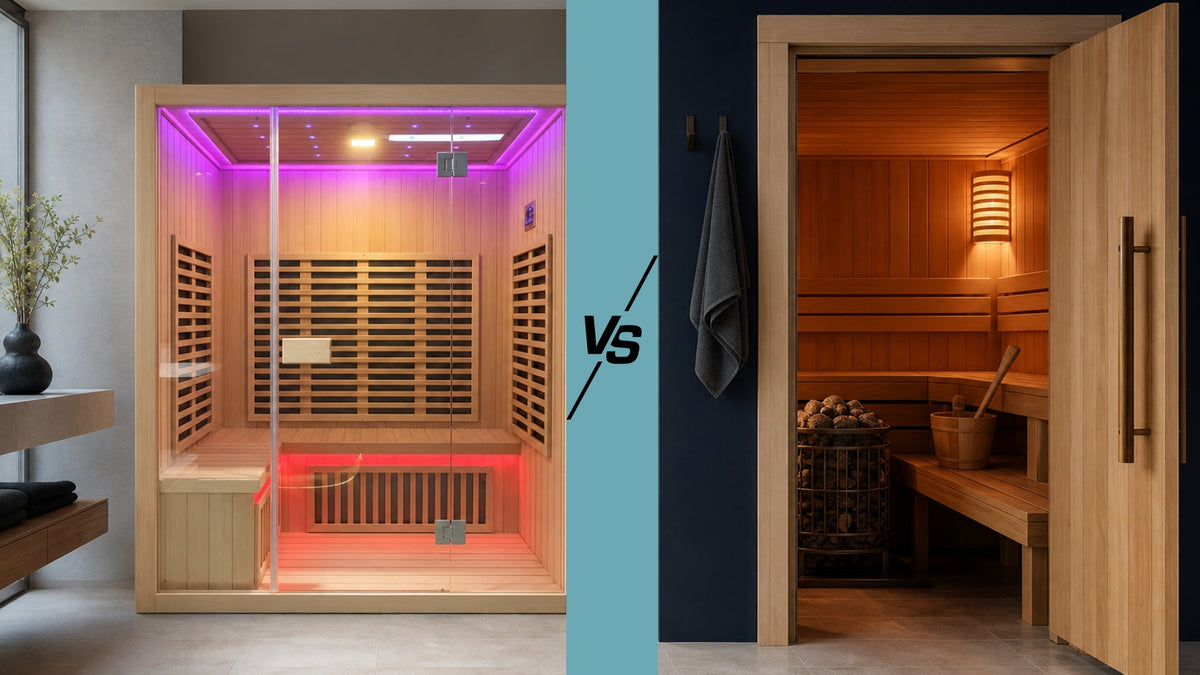
Quick answer: Choose infrared if you want a lower-temperature, radiant-heat experience that is often simpler to place inside a home. Choose traditional if you value high air temperatures, heated stones and the option of steam. Neither is universally “better”; the right choice is the one that fits your preferred feeling, available space, installation requirements and routine.
Most sauna comparisons begin with specifications. A better place to begin is the moment you want to create. Are you looking for a quiet evening cocoon with gentler surrounding air, or the enveloping intensity and ceremony of a hot traditional room?
Infrared sauna vs traditional sauna at a glance
| Question | Infrared sauna | Traditional sauna |
|---|---|---|
| How is heat delivered? | Radiant panels warm the body and nearby surfaces more directly. | A heater warms the air and stones; water may be added to suitable stones for steam. |
| How does it feel? | Deep, steady warmth with a lower room temperature. | Hotter surrounding air with a more intense, enveloping sensation. |
| Typical routine | Often chosen for convenient, repeatable home sessions. | Often chosen for a traditional high-heat ritual and social bathing. |
| Moisture | Usually a dry experience. | Can be dry or more humid when water is used on an appropriate stone heater. |
| Installation | May be available as a self-contained cabin, subject to electrical and clearance requirements. | Often needs more planning for heater capacity, ventilation, heat protection and electrical work. |
Exact temperatures, warm-up times and electrical requirements vary by model. Always compare the manufacturer’s specification rather than relying on generic category averages.
Choose infrared if you want warmth without the fiercest air temperature
An infrared cabin can suit someone who wants to sit, breathe and unwind without recreating the sharp, high-air-temperature character of a traditional sauna. Radiant panels are positioned around the seating area, and many home models arrive as freestanding timber cabins.
The emotional advantage is ease: the ritual can feel accessible enough for an ordinary weeknight. That matters because a theoretically perfect recovery routine has little value if it is too demanding to use.
Choose traditional if the ceremony is the point
Traditional sauna users often love the hot air, the scent of timber and the sensory change created by water on heated stones where the heater is designed for it. The experience can feel more intense and communal. It may also require a more involved room design and installation.
If what you remember from a favourite spa or Nordic trip is the heat rolling through the room, a traditional sauna may be closer to that expectation.
Which type has better health benefits?
This question needs a careful answer. Observational research around frequent Finnish sauna bathing is often quoted alongside infrared products, but findings from one heat method cannot automatically prove the same outcomes for another. A review of dry-sauna interventions included both Finnish and infrared studies and found potentially positive results, while also noting important limitations and wide variation between protocols.
Both formats can support a personal relaxation routine and both expose the body to heat. Neither should be sold as a guaranteed treatment for cardiovascular disease, pain, sleep problems or mental-health conditions.
Read the peer-reviewed systematic review of regular dry sauna bathing for a fuller view of the evidence and its limitations.
Five questions to decide what belongs in your home
1. What feeling are you trying to create?
Choose infrared for steady, lower-temperature warmth. Choose traditional for hotter air, stones and a more classic sauna atmosphere.
2. Where will it live?
Measure the full route from delivery point to installation area, not just the final footprint. Check ceiling height, floor loading, ventilation, moisture, drainage where relevant and all required clearances.
3. Who will use it?
A one-person cabin protects personal quiet time and uses less space. A larger cabin makes the ritual social but needs more room and may have different power requirements.
4. What installation can your property support?
Never assume an ordinary socket, garden room or extension lead is suitable. Use the product manual and involve a qualified electrician or installer where the specification requires it.
5. Which routine will you repeat?
Imagine a wet Tuesday in November. Which option would you genuinely turn on and use? That answer is often more valuable than a long feature list.
Before buying a home sauna in the UK
- confirm indoor or outdoor suitability in writing;
- check the stated capacity against internal bench dimensions;
- review power supply, plug type and professional-installation requirements;
- understand delivery access and assembly responsibility;
- compare warranty exclusions, replacement parts and support;
- follow heat-safety advice and seek medical guidance when appropriate.
If infrared matches the experience you want, compare the Still & Surge home infrared sauna range.
The bottom line
Infrared and traditional saunas are not two versions of the same purchase. They create different kinds of heat and different rituals. Choose the atmosphere you want to return to, then let space, installation evidence and product support narrow the decision.


Leave a comment
This site is protected by hCaptcha and the hCaptcha Privacy Policy and Terms of Service apply.